Revere Wood Flooring has handled hardwood floor repair in Revere, MA for more than 20 years, serving surrounding cities including Chelsea, Nahant, Winthrop Town, Everett and Malden. Repair is the part of this trade that cannot be bought off a shelf: matching a 1920s red oak strip floor, weaving boards into an existing run, or making a radiator opening disappear is hand work, and it is where an experienced crew separates itself from a price per square foot.
It matters here because of what is on the ground. Revere counts 24,139 housing units, 6,219 of them built in 1939 or earlier and 65.4 percent built before 1980. Floors that old have been patched, carpeted, uncarpeted, plumbed through and lived on hard, and they are frequently worth saving — old-growth material of that quality is not available new.
Every repair quote we write separates the repair from the refinishing, so you can see what the hand work costs and what the sanding costs. Where a repair is not worth doing, we say that too.
Repairs That Save The Original Floor
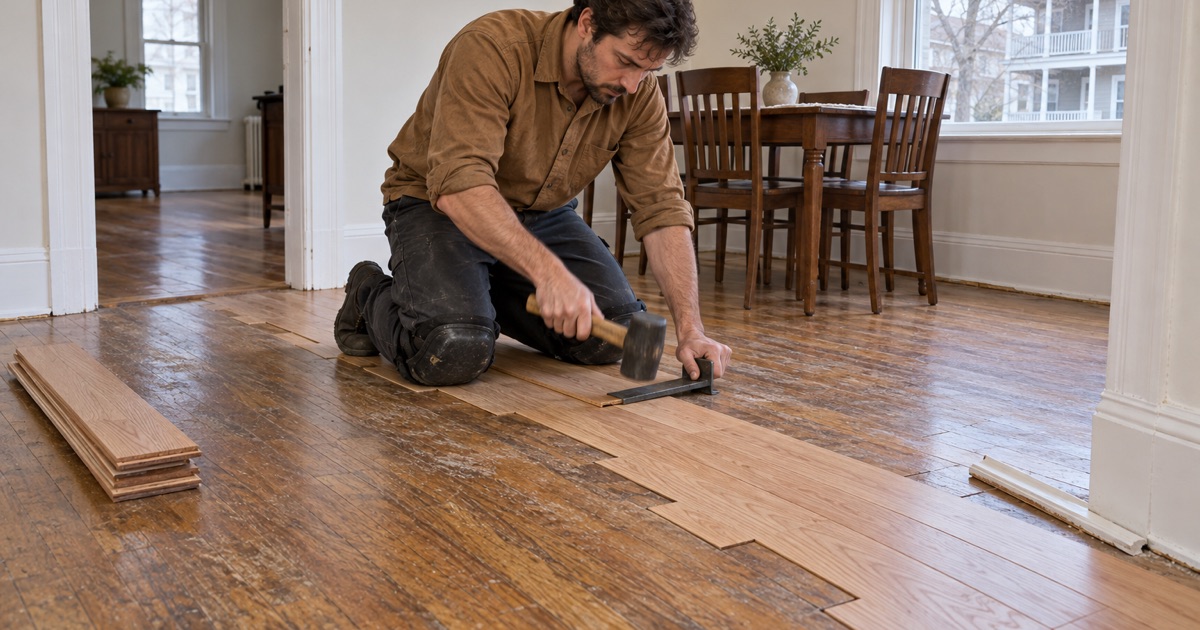
Weave-In Board Replacement
A weave-in cuts out only the damaged boards and staggers new stock into the surrounding runs, keeping the tongue and groove engagement at the edges of the opening. Done properly the seam follows the same random pattern the original floor has, so there is nothing for the eye to catch. A square patch dropped into a floor reads as a repair from across the room no matter how well it is finished.
Radiator Removal Patches
When a steam radiator or its riser comes out, what is left is an unfinished footprint and a hole through the boards. We patch with matching species and width, woven into the existing runs rather than filled, and we do it before any sanding happens. That sequence is the entire difference between a patch nobody notices and one that is visible from the doorway for good.
Squeaks, Loose Boards And Backed-Out Fasteners
Squeaks come from movement — a board working against a fastener, or a subfloor that has separated from the joist below. We locate the actual movement, refasten into framing where the layout allows, and replace flooring cleats or staples that have lost their grip. Filling a nail hole without finding the cause silences nothing and leaves a mark in the finish.
Damage That Needs More Than A Sanding
Pet Urine Staining Through To The Subfloor
Black urine stains are a reaction inside the wood, not a film on it, and where they reach the subfloor they sit deeper than any sander can go. Those boards come out, the subfloor underneath is treated or replaced, and matching stock is woven in. Anybody promising to sand a black stain out is describing a floor you will be unhappy with once the finish dries.
Burns, Gouges And Impact Damage
A burn from a fireplace ember, a gouge from a dropped appliance or crushing under a piano leg all share one property: the damage is below the depth a sanding can reach. Surface scratches sand out, these do not. We replace the affected boards and blend the repair into the room’s finish rather than leaving a low spot that catches light at an angle.
Powderpost Beetle And Carpenter Ant Damage
Fine round exit holes with powder beneath them point to powderpost beetles; larger galleries and coarse shavings point to carpenter ants and usually to a moisture source. We determine whether the activity is live or historic, replace boards that have lost structural integrity, and coordinate treatment where it is current. Finishing over live insect activity wastes the whole job.
Matching Old Boards In A Pre-War House
Species, Cut And Grade
Red oak and white oak look similar raw and diverge sharply once stain is on. Plainsawn next to rift and quartersawn shows a completely different grain figure. Select grade beside a common grade floor with knots and mineral streak reads wrong immediately. We identify all three on your floor before sourcing, because getting any one of them wrong makes the repair permanent and visible.
Board Width, Thickness And Milling
Older floors were milled to widths and thicknesses that current stock does not always match, and tongue and groove profiles have changed. Where the sizes do not exist off the shelf we mill to suit or source reclaimed material of the right era. A board of the right species in the wrong width is still an obvious patch.
Blending Color Across Old And New Wood
Even a perfect species match starts out lighter than the floor around it, because decades of light and finish have changed the old wood. The fix is sanding the whole area to bare and finishing it together, so new and old take the same stain and the same coats. Where a client wants the room untouched, we say honestly how visible the difference will remain.
Structural Problems Under The Finish Floor
Subfloor Deflection And Joist Movement
A floor that flexes underfoot is telling you about the structure beneath it, not about the finish surface. We check subfloor fastening and thickness and look at the span, then correct what can be corrected from above. Where the problem is framing rather than flooring, we tell you plainly, because laying new wood over a deflecting subfloor reproduces every symptom within a year.
Hollow Spots And Failed Adhesive
On parquet and glue-down floors a hollow note underfoot means the bond has let go in that area, often over black mastic in an older apartment building. We map the failed zones, lift only what has released, clean the substrate back and re-bond with new material. Coating over a delaminated area seals in a section of floor that is going to come loose anyway.
Threshold, Reducer And Transition Repairs
Thresholds, reducers and stair nosings take more abuse than the field of the floor and are usually the first thing to fail. Replacing them is quick work, but getting the height relationship right between two different floor thicknesses is not, and a bad transition is a trip hazard as well as an eyesore. We rebuild them to match the species and the finish of the floor rather than fitting a stock strip.
How A Repair Visit Runs
Assessment And Moisture Check
We look at the damaged area and the rooms around it, identify species, cut and width, check remaining thickness above the tongue, and take moisture readings if water is involved. Anything that has to be resolved before flooring work — a leak, an insect problem, a structural issue — is identified at this visit rather than discovered mid-job.
Sourcing And Written Scope
You get a written scope that separates board replacement, patching, fastening and refinishing into their own lines, with the species and grade of the replacement material named. If the match will be imperfect, that is stated in the scope rather than mentioned on the day.
Repair Before Sanding
All board replacement, patching and refastening happens before the first abrasive pass, without exception. This is the sequencing rule that makes repairs invisible, and it is the single most common thing done out of order by crews working to a schedule rather than to the floor.
Finishing The Area As One Floor
The repaired area is sanded and finished with the surrounding room so that old and new wood take the same stain and the same coats. We hand over the walk-on, furniture and rug dates the same way we would on a full refinishing job, because the finish does not know it was only part of a room.
- 20+ Years on New England Floors
- Free Written Estimates
- Dustless Sanding