Revere Wood Flooring builds, strips and refinishes hardwood stair treads in Revere, MA, serving surrounding cities including Chelsea, Nahant, Winthrop Town, Everett and Malden. Stairs are the part of a wood floor job that separates crews, because none of it can be done by machine — every tread is fitted, every riser is cut to its own opening, and no two steps in a pre-war house are quite the same size.
They are also the most looked-at wood in the house. A stair run sits at eye level from the hall, catches the most light and takes the heaviest concentrated wear of any surface in the building. A floor with a tired staircase running through it reads as a tired floor, however good the rooms are.
We quote stairs by the tread and the riser rather than folding them into a square-foot number, so what the hand work costs is visible to you before anything starts.
What Goes Into A Stair Run
Treads, Risers And Nosing
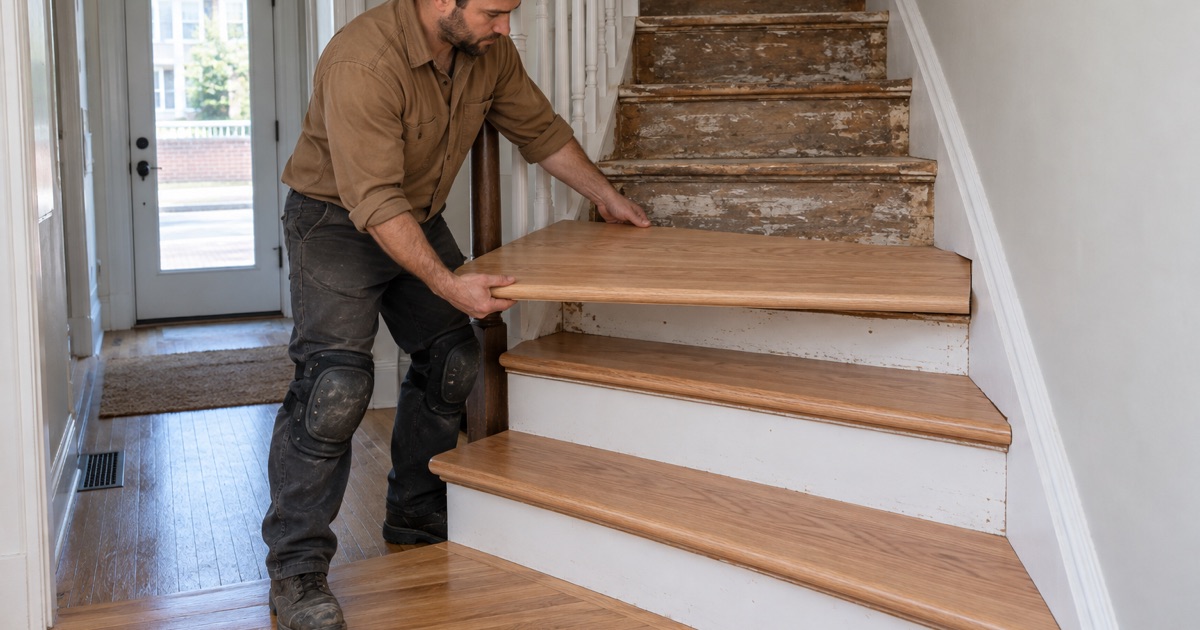
The tread is the part you stand on, the riser is the vertical face between treads, and the nosing is the rounded or square edge that projects past the riser. All three are replaceable independently, and the nosing profile is what ties the stairs visually to the floor at the top and bottom. Getting the nosing wrong is the detail people notice without being able to say why.
Skirt Boards, Returns And Stringers
A finished stair also has skirt boards running up the wall, mitered returns on any open side, and stringers carrying the structure underneath. Open-sided stairs need returns cut and mitered for each tread, which is slow, exacting work. These are the components that decide whether a converted stair looks built or looks covered over.
Matching Stairs To The Floor Below
Stairs almost always have to relate to an existing floor, and the match has to work in species, cut and grade before color is discussed. The best result comes from sanding and finishing the stairs and the adjoining floor at the same time, so both take identical stain and coats. Finishing stairs separately from the hall they land in is how two woods that should match end up visibly different.
Converting Carpeted Stairs To Wood
What Is Under The Carpet
Pulling carpet off a staircase produces one of two findings. Occasionally there is a finished hardwood stair underneath that only needs staples, tack strip and pad residue removed before refinishing. Far more often the treads are construction-grade softwood never intended to be seen, with the outer edges left unfinished where the carpet wrapped. We look before quoting, because the two cases are entirely different jobs.
Retreading Over Existing Stairs
Where the existing treads are not presentable, the usual answer is retreading: new hardwood treads, risers and nosings fitted over the sound existing structure. It keeps the stair geometry intact, avoids framing work and produces a finished stair in hardwood of your choice. Each step is templated individually, since older runs are rarely identical from bottom to top.
Landings, Winders And Curved Steps
Landings, winder steps that turn a corner and bullnose bottom treads all need their own templates and none of them can be cut from a standard blank. They are where a stair conversion either reads as custom joinery or as a kit forced into place. We template and cut these on site, and we price them separately because they carry real hours.
Refinishing And Stripping Existing Stairs
Sanding Treads By Hand
A stair tread is sanded with hand tools, small orbital equipment and scrapers into the corners, working through a grit sequence exactly as a floor does but without the machines that make a floor fast. Nosings need particular care, because that is where the finish has usually worn through first and where over-sanding changes the profile.
Stripping Painted Treads And Risers
Painted stairs are common in houses of this age, and in any home built before 1978 the paint is a lead-safe question before it is a finish question. Under the state’s renovation rules, power sanding painted surfaces without HEPA-filtered exhaust is prohibited, so those treads are stripped and hand-worked instead. It is slower and more expensive, and it is not optional.
Repairing Loose Treads And Squeaks
A squeaking or moving tread is usually a wedge that has dried and loosened, or a tread that has separated from its riser. Both are generally reachable and fixable without rebuilding the stair, and both are addressed before any finishing work. A staircase that has been beautifully refinished and still moves underfoot has had the wrong problem solved.
Living With The Job And What It Costs
Quoted By The Tread And The Riser
Our quotes count the treads, the risers, the returns, the landings and any winders, and price the hand work on each. That makes the number legible: you can see exactly what a fourteen-step run with open returns costs against a closed one. It also means nothing gets absorbed silently into a square-foot rate that was never meant to carry it.
Keeping A Route Between Floors
Stairs are the one surface a household cannot simply avoid for two days. We stage the run so there is a usable route between floors for as much of the job as the layout allows, and we tell you in advance which hours the stairs are genuinely out of service. In a two-family the shared stair is scheduled last, after both units are done.
Finish, Sheen And Slip
Stair treads take concentrated wear on a narrow strip of wood, so the finish works harder here than anywhere else in the house. Satin and matte sheens give better grip underfoot than gloss and disguise wear on the nosing far longer. Where slip is a real concern for the household, we discuss runners and treatments openly rather than leaving somebody to find out on the first wet day.
- 20+ Years on New England Floors
- Free Written Estimates
- Dustless Sanding