Revere Wood Flooring has been helping clients replace carpet with hardwood in Revere, MA for more than 20 years, serving surrounding cities including Chelsea, Nahant, Winthrop Town, Everett and Malden. It is the most common request we get in older houses, and it is also the request most likely to change once we lift a corner of the carpet and look underneath.
That is not a sales line. Revere counts 6,219 housing units built in 1939 or earlier and 10,807 built before 1960, and wall-to-wall carpet went down over a great many original red oak floors in the decades after that. Where the floor underneath is sound, refinishing it costs a fraction of installing a new one and gives you material that cannot be bought new at any price.
So the job starts with a look rather than an order. If there is a floor worth saving we will tell you, even though it is the smaller job. If there is not, we take the whole carpet layer out properly and put down a floor that will still be there in fifty years.
First Question: Is There Already A Floor Under There?
Lifting A Corner Before You Commit
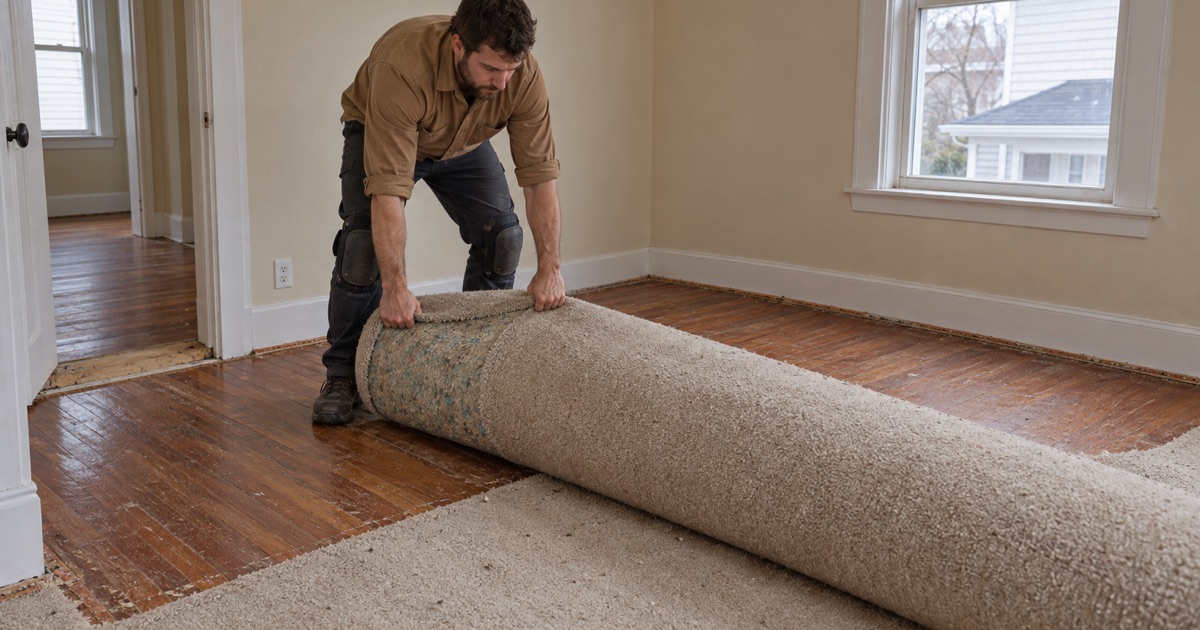
A closet, a spot behind a door or the edge of a run is enough to see the species, the width, the direction and the general condition. It takes minutes and it can change the entire scope of the project. We do this at the estimate rather than on the first day of work, because discovering an oak floor after the new material has been ordered helps nobody.
Restoring A Found Oak Floor
A floor that has spent forty years under carpet is usually in better condition than the exposed floors around it, because carpet protects wood from light and wear even as it hides it. What it will have is staple holes, tack strip damage at the perimeter and sometimes paint overspray. All of that sands out, and the result is an original floor at refinishing prices.
When What Is Underneath Is Not Worth Saving
Sometimes the answer is no: particle board, plywood subfloor with no finish floor at all, softwood never meant to be seen, or oak already sanded past its limit. We measure the remaining thickness above the tongue rather than judging by eye, and where the number does not support a sanding we say so and price a new floor instead.
Getting The Carpet Layer Out Properly
Pad Residue, Staples And Tack Strip
The carpet lifts in minutes. What takes the time is the pad stuck to the boards, the hundreds of staples holding it down, and the tack strip nailed around every wall. Every one of those has to come out before an abrasive or a new floor goes anywhere near the subfloor, because a single missed staple destroys a sanding belt and scars whatever it touches.
Linoleum, Adhesive And Older Coverings
In houses of this age the carpet is often not the first covering. Linoleum, sheet vinyl and their adhesives frequently sit underneath, particularly in kitchens and halls. Those layers are removed deliberately and the substrate cleaned back rather than sanded through, and we allow for the possibility in the estimate so an extra layer does not become an extra bill.
Dust, Disposal And What Leaves The House
Decades-old carpet and pad carry a great deal of dust, and taking them out is the dirtiest part of the job. We bag and remove the carpet, pad, strip and fasteners, vacuum with HEPA equipment and leave the substrate clean. In a pre-1978 home that containment discipline is a legal expectation once painted surfaces are being disturbed, not just good manners.
Preparing The Subfloor For Hardwood
Flatness, Fastening And Squeaks
With the carpet gone the subfloor is visible for the first time in years, and this is the moment to fix it. We check flatness across the whole area, refasten loose boards into joists and correct high and low spots. Hardwood laid over a subfloor nobody flattened telegraphs every high spot as a squeak within the first year, and by then it is under a finished floor.
Moisture Readings Before Anything Goes Down
Carpet holds moisture and hides evidence of past leaks, so readings are taken across the room and into the substrate before any new material is ordered. Where a slab is involved the test is non-negotiable, because it determines whether solid hardwood is even a legitimate option. Readings are repeated on delivery and again immediately before installation.
Height Changes At Doors And Transitions
Carpet and pad together are usually thicker than a wood floor, so the finished height almost always changes. That affects every doorway, every threshold into a tiled room, the bottom step of any staircase and sometimes the swing of a door. We map all of it at the estimate and include reducers, thresholds and door trimming in the written scope.
Choosing The New Floor
Solid, Engineered Or Prefinished
Over a wood subfloor above grade, solid hardwood is usually the right answer and gives you a floor that can be refinished repeatedly. Over concrete or below grade it is engineered material with a vapor retarder. Prefinished boards suit a tight schedule or an occupied home; site-finished gives a continuous surface and an exact match to adjoining rooms.
Matching An Adjoining Room
When a carpeted room opens onto an existing wood floor, the new floor has to relate to it in species, cut, grade, width and direction before color is even considered. The cleanest result comes from sanding and finishing both together so they take the same stain and coats. Where an exact match is not possible, a deliberate transition reads far better than a near miss.
Stairs, Landings And The Rest Of The House
Carpeted stairs running between newly wooded floors are the loose end that clients most often regret leaving. Converting them at the same time means one mobilization and one finishing schedule, so the treads, the hall and the landing all match. We quote the stairs separately by the tread and the riser, so you can see exactly what adding them costs before deciding.
- 20+ Years on New England Floors
- Free Written Estimates
- Dustless Sanding